Walking
tours in London
Jack
the Ripper
In
the Autumn of 1888 terror stalked the streets of London's East
End. The horribly mutilated bodies of local prostitutes bore witness
to this series of ghastly crimes which were never solved. We will
visit the murder sites and hear the evidence which has baffled
the experts for over a hundred years. (Your guide will put this
in the context of the social environment of the East End in that
year). (Many of the details were considered too gruesome for the
newspapers of the day, but as more has been revealed over the
ensuing century, your guide will be able to bring you up to date
with all the most recently revealed evidence.) Among the suspects
were a royal Duke, a society doctor, and an eminent lawyer - and
most recently of all, well- founded suspicions have rested on
an American quack. Draw your own conclusions!
Back
to the top
An
evening in Soho
Come
off the beaten track and visit the "off-beat" in Soho,
in London's bohemian "red-light" district. This former
haunt of the aristocracy became a melting pot for European emigres
and writers, prostitutes and barrow boys, rock bands and raconteurs.
Recent years have seen many changes in Soho, with the world's
oldest profession being replaced by the world's newest, the media.
Come and see where Karl Marx lived, Paul McCartney works and where
Nelson spent his last night before the Battle of Trafalgar.
Back
to the top
Covent
Garden - its actors and authors
The
setting: the colourful market where high and lowlife mingle.
Among
the cast: respectable writers such as Charles Dickens and Jane
Austen; raffish actors like Garrick and Kean; a much loved ghost
and the blind man who knew 3,000 villains by the sound of their
voices.
The
backdrops: the Actors' Church; London's oldest working theatre;
the stage door where a jealous actor murdered his rival and the
hidden restaurant where the stars of today relax after the show.
Back
to the top
Shakespeare
and Dickens' London - a pub walk
Southwark,
on the south bank of the river Thames, the Soho of 16th century
London. Here, in a rich and seedy mix, were found bishops, brothels,
bards and bars.
Discover
the original site of the Globe theatre and see the reconstruction
of the Globe nearby. Visit the church of Shakespeare where his
brother is buried and where John Harvard was baptised. See the
remains of the Bishop of Winchester's palace and the infamous
Clink prison. Hear about the 19th century slums which infested
this part of London and the Marshalsea , where Dickens' father
was imprisoned for debt.
We
stop for a drink at the pub which was Shakespeare's local, and
finish the tour at London's only surviving galleried coaching
inn.
Back
to the top
The Houses of Parliament
and Big Ben
|
Government
and Democracy
The "Cradle of all Free Parliaments" is at Westminster
where we trace the origins of British democracy from its medieval
beginnings in the Chapter House of Westminster Abbey to the present
day. The Royal Palace of Whitehall gave its name to the wide road
now lined with grand ministry buildings. Whitehall Palace Banqueting
House survives and we see where Charles 1 went to his execution.
Passing Downing Street, where Britain's Prime Ministers have lived
at No. 10 for 220 years, we end our walk at Winston Churchill's
Cabinet War rooms where Europe's history was made in the dark
days of the blitz.
NOTE:
In the summer recess tours are available with Blue Badge guides
between 31st July and 3rd October
inclusive. Click HERE
for details
Back
to the top
Buckingham Palace
|
Royal
London
Our
Royal walk takes us through St James Park with its eye-catching
views to the famous Mall where we can see the elegant Regency-style
Carlton House Terrace. We pass the statue of King George VI and
view Marlborough House, originally the London home of the ancestors
of Winston Churchill and later the residence of many heirs to
the throne and widowed Queens. Then comes Tudor St James's Palace,
built for King Henry VIII in the 1530s and now the London home
of the Prince of Wales. Next door we see Clarence House, the former home of the late Queen Mother and now the London residence of Prince Charles and his second wife Camilla, Duchess of Cornwall.
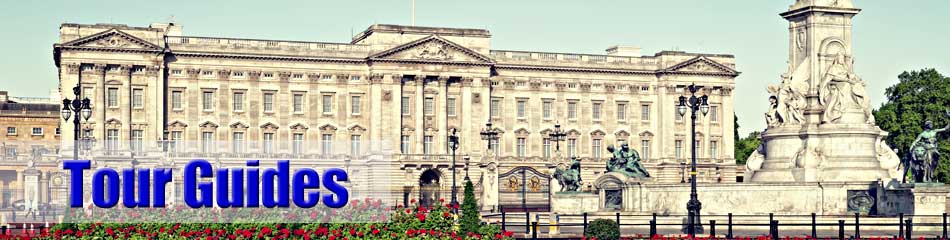
Ahead of us now is Buckingham Palace, official residence of Her
Majesty the Queen and scene of some much royal pageantry and we
will finish the tour by the Queen's Gallery and Royal Mews.
Back
to the top
|
Albert
Memorial
The
Albert Memorial, completed in 1876, was designed by George
Gilbert Scott. Prince Albert sits in the centre of the 200
ft/61 metre high memorial, amid symbolic imagery relfecting
his interests - the arts and sciences - and also moral virtues
and religion. The principal materials of the monument are
Campanella marble, granite, glass mosaic, limestone, sandstone,
semi-precious stones and gold leaf. All have recently been
restored under the supervision of English Heritage, at a
cost of £11 million. Only by taking one of our tours
do you gain access behind the outer railings to see closely
the bravura marble carving of the Parnassus frieze comprising
169 figures of renowned poets, musicians, painters, sculptors
and architects. |
 |
|
Public tours lasting 50 minutes every 1st Sunday of the month
for 2005 at 14.00 + 15.00. Tix cost £4.50/£4 concessions
+ English Heritage members. No need to book just meet the
guide directly in front of the Memorial beforehand and pay
then.If you are a group of 10+ call us on 020 7495 5504 to
check availability. Ad hoc tours are available via prior arrangement
for groups at almost any time that the park is open @ £145
for up to 25 persons. TOUR INFORMATION |
Bloomsbury
- the intellectual centre of London
This
small village just outside the City of London becomes the fashionable
new residential quarter on the Duke of Bedford's estate in the
1670s and 80s with titled people moving in, followed in the next
century by lawyers and other professional classes and the British
Museum.
The
mid and late eighteenth century periods saw the building of a
series of elegant terraces and squares of Georgian houses. In
the early nineteenth the capital at last had a university in the
form of University College in Gower Street and now a large part
of the area is occupied by University institutions.
The
scene was thus set for Bloomsbury to become a great intellectual
centre and is now particularly remembered for the early twentieth
century characters such as Virginia Woolf, Lytton Strachey, Duncan
Bell, John Maynard Keynes ... who "lived in squares and slept
in triangles".
Back
to the top |